Monday, May 6, 2013

Palm Pipes and Tuning Forks

This week, our two labs consisted of experimenting with sounds and waves.

In our first lab, we measured the frequencies of tuning forks. The frequency (Hz) is the rate at which something occurs or is repeated over a particular period of time. Once we hit the fork on the sole of our shoe, we placed the Lab quest microphone next to the fork to measure the waves. We understood that the sound waves were harmonics since Ms.Tye told us the tuning forks relate to music. These harmonics and standing waves only occur at certain frequencies (shakes/second).

Fromt he graph on the Lab quest, we saw that each frequency was proportional to the others. Together, these frequencies create music or a blend of harmonics.


Instruments project many harmonics at once which is why we hear music oppose to just noise.

In our second lab, we investigated woodwind instruments and how they are different from string instruments. Our table was given 4 PVC pipes of different lengths.
First: We measured the length and diameter of the tubes in meters.
Second: We used the wavelength equation...L=(1/4 x (wavelength))-(1/4 x (diameter)) to get the length of the wave.
Third: The answer we got from the previous equation was plugged into V=wavelength x frequency to find the frequency.
Fourth: With our frequency, we were able to use Wolfram Alpha to find the note of each pipe.

So in class, we played happy birthday and twinkle twinkle with our pipes. Here is a video of a guy playing more elaborate songs ONLY with PVC pipes! Check it out! It's wicked awesome.


So...what is sound?

Sound are places of no movement of air molecules and places of movement of air molecules.


Monday, April 22, 2013

Light an Optics Unit

For the last couple of weeks, we were learning about light,mirrors and lenses. One main idea was about refraction which is a change in direction due to a change in medium.

Key Ideas

  • Path of Least Time: light will find the quickest route to an endpoint
  • If there is one medium/material, the path of least time will be a straight line from start to finish.
  • If there are two mediums/materials (2 velocities), the path of least time will be at the point that the medium changes which is ultimately refraction.
Snell's Law

This law allows us to find the straw's angle of refraction from air to water. As you can see from the picture above, the pencil looks like it's bending when it changes medium.
Air: index of refraction=1
Water: index of refraction=1.33


Thursday, March 21, 2013

Magnetism

STANDARD 6.3

Explain how objects like the Earth and metals can be permanent or temporary magnets

To determine if a magnet is temporary or permanent, it has to do with domains=groups of aligned magnetic fields.

Permanent Magnetic Materials


All the domains or fields line up in these objects which make them permanently magnetic. Some of the most common permanent magnets are nickel, iron, and cobalt.

Ever wonder why the Earth is a magnet? Well, the core of the Earth consists of metals. As we all know, metals contain moving charges. This means that the Earth is pretty much a giant magnetic field.

Temporary Magnetic Materials

From our lab in class, we know that paperclips are temporarily magnetic. Why? Because once the domains are in the presence of an atom, they line up. Without it, the domains are scattered in different directions.

Non-Magnetic Materials


Last but not least we have non-magnetic materials. They do not have any magnetic domains. Unlike the first 2 examples, this material will do nothing in the presence of a magnetic.


Monday, February 11, 2013

Electrostatics

Big Question: How is electricity generated and employed to do useful work?

This past week, our class was introduced to electrostatics! In class, we experimented with a lemon battery and a Van de Graaf generator. Both of these experiments taught us about voltage, charge, affinity, and electrical potential energy.
REMEMBER!
-Protons NEVER move, only electrons
-Opposite charges attract (+)(-), Like charges repel (+)(+) and (-)(-)
-Through friction, we transfer charge
-If there is a neutral object, only attraction. Never repelling


As you can see in the picture above, we used a lemon battery to help us learn the lessons. The battery (lemon) had a neutral charge from the penny (-)and the zinc nail (+). We connected each lemon with wires. The wires would connect the lemons by touching the opposite charges (penny to zinc nail) or vice versa. Later, we were challenged to make an LED bulb light up. To do this, we needed a lot more materials! Once the voltage was at about 3, we connected the bulb to the circuit and it lit up! Why did this happen? We made the lemon "do work" with the acid chemical reaction within the lemon. The wires, pennies, and zinc nails helped us complete the electrical circuit.

This concept is used in our IPad batteries! An IPad is shaped because of the battery used to power it. The battery is made of lithium-polymer. When we charge our IPads, the ions move from the anode to the cathode. When the battery is dead and not charging, the ions move back to the anode again. If you didn't know already, ions are charged atoms which either gained or lost electrons. Hence, plugging in our electronics to "charge" them. The outlet acts like a mountain. There is a separation of positive and negative charges. The mountain only separates the charges. It does not contain stored energy.


As you can see, the charges run up or down the hill which is created from the attraction of opposite charged or the opposition of like charges. An IPad battery has charges or electric potential energy.This energy allows us to power up our IPads.

Wednesday, January 23, 2013

Projectile Motion

Big Question-What is a projectile? What is the general path of motion?

There are 3 different types of projectiles
1) When an object is dropped from being at rest.
2) When an object is thrown vertically upward.
3) When an object is thrown upward at an angle or horizontally.

When there is only gravity acting on an object, it is considered a projectile. In the diagram below, we drew out 4 Velocity v Time graphs. Remember now! The slope of a Velocity v Time graph is ALWAYS acceleration. As you can see, some of the graphs show that the ball is accelerating. The two x-component graphs have a constant slope and velocity. The two y-component graphs depict the ball slowing down until it reaches the highest position. Then, the ball accelerates down while speeding up.


During our post game analysis, we analyzed our graphs and found the slope of everyone's shot. our table worked together to find the average number of our slope and compared it to the class. We realized the the average slope of the entire class was 10.2. Sounds like a familiar number, right? That's because the gravitational pull on Earth is 10N/kg. Gravity was the only force acting on the basketball. This explains why when the ball travels upwards, the velocity slows down. The ball starts to speed up once it reaches the top of the y-axis as it travels downward!


Monday, January 14, 2013

Hover Disk-Centripetal Force Lab

Big Question #1-What does it mean to analyze forces in 2D?

Last semester, we studied forces primarily in 1D. This meant that the fores only had a x-component or a y-component. To start off the year, we are studying forces in 2D. The forces are no longer straight up and down but, at an angle. To make our life easier, we can break up the angle up into x-component and y-component. Forces are vectors! Meaning they have both magnitude and direction (which we learned last year.) To solve for the value of a 2D force, first we break up the direction into the x-component and y-component. Next, we solve for the magnitude of the x-component and y-component by using Trigonometry. (SOH CAH TOA) REMEMBER! THe components of the force can be positive OR negative. We had to find the value of the x-component and y-component separately to find the net force of x and y separately.


Big Question #2-How do forces cause objects to move in circles?

In our first lab of the year, we used a hover disk with a string attached to it. With the disk on, I would hold the string and spin the disk around me in a circular motion. Since there was a string, we know that tension force (Ft) plays a big part in the lab. The center pointing force AKA the centripetal force in this lab was the tension force. The disk continued to accelerate because its direction of motion was constantly changing even if the disk's speed wasn't changing. Later, Ms. Tye showed us that when we let go of the string while the disk is spinning in a circular motion, it ends up going in a straight line tangent to the circle after it's released because the force and velocity are perpendicular to each other!

Big Question #3-What does it mean to be in orbit? How do satellites orbit planets and how do plants orbit the Sun?

To be in orbit means to continually follow a curved path around an object. Like the hover disks, the satellites orbit the planets in the same style. As the string (Ft) acted as the centripetal force to the kick disk, satellites orbit planets due to the centripetal force of gravity. The gravity is centered towards the planet thus, causing the satellite to orbit. Likewise with planets that orbit the sun due to gravitation force as a centripetal force. If the sun suddenly vanished, the Earth and all the other planets will eventually fall out of orbit and continue traveling at a straight line just like the hover disk lab.


Monday, November 19, 2012

Newton's 3 Laws of Motion

Big Question #1-What gives rise to a change in motion?

The only thing that can change the motion of an object is a net (unbalanced) force acting on it. This is given by Newton's First Law of Motion, sometimes also called the Law of Inertia.

In the hover disk lab, we learned about Newton's 3rd Law of motion which states that forces are equal and opposite. With the fan underneath the hover disk, we eliminated friction. We used interaction and free body diagrams to record out diagrams to record our data.


Big Question #2-What is the relationship between mass, force, and acceleration?

Later we performed the fan cart lab. We performed 5 different trials using 5 different masses to collide the fan cart with the aluminum ring. With the help of LoggerPro to calculate our slope (acceleration), we concluded that F=ma. The fan cart helped us learn about Newton's 1st and 2nd Law

Overall, we learned that F=ma or Force=Mass X Acceleration. The net force acting on an object will cause acceleration.
 There are also about 6 different types of forces: gravitational, normal, friction, tension, spring, and buoyancy. Interaction and free body diagrams help us explain what's going on in the lab.

Real Life Connection-Jumping!
Newton's 3rd Law of motion is applied to jumping like in basketball. An athlete can jump higher off a solid surface because it opposes his body with as much force as he is able to generate, in contrast to sand or other unstable surface.


Monday, October 29, 2012

Impulse Lab

Big Question
What is the relationship between impulse, force, and time in a collision?

In this week's lab, we collided 2 aluminum rings. One ring was attached to a car and the other on a force probe stand. The rings help to slow down the collision so we could analyze the experiment better. We measured the velocity with the sonic probe.

Data

  • Mass of cart=0.25g
  • Velocity before collision=0.4833 m/s
  • Velocity after collision=-0.4008 m/s
  • Area under F v T graph=-0.2580 N/s
    • Impulse=area under a F v T graph-->J=Ft OR
    • Impulse=change in momentum (Kgm/s)-->J=P final-P initial


Big Question #2
Which ring will bend more? Red car or blue car?

After the lab, we crashed a red car with less mass and a blue car with more mass. Aluminum rings were attached to both of the cars.

The rings bend the SAME amount

In any collision, no matter what the mass, there is an equal and opposite force! Since the red car has less mass, there is a greater change in momentum. Force and time are inversely proportional (increase T, decrease F) but impulse remains constant.

J     =      F      x      T 
(NxS)    (N)          (s)
(Kgm/s) (Kgm/s)  (Kgm/s)

Real Life Connection-Landing in Basketball!


When Michael Jordan goes for a dunk, he later bends his knees when he lands. By bending his knees, it increases the time of him landing which decreases the amount of force created from the force of the floor on his knees. There is an equal and opposite force on his knees and the floor. The impulse will always stay constant.


Monday, October 15, 2012

Collision Lab

Big Questions


  • What is the difference between the amount of energy lost in an elastic collision vs. an inelastic collision?
  • What is a better conserved quantity-momentum or energy?
In this week's lab, we performed an elastic and an inelastic collision to see how momentum and kinetic energy would be affected. Ms. Tye changed up the purpose of the lab this time! Prior to the lab, we already knew the equation p=mv or momentum=mass x velocity. The purpose of the lab was to prove and understand why momentum is used to analyze collisions. We used two cars with a mass of 0.25 kg each for our experiment. In the elastic collision, the cars collided and bounced off each other due to the spring launchers. In the inelastic collision, the cars collided and stuck together due to velcro. We also learned about scalar and vector quantities. A scalar quantity are simple values without any certain direction (mass, temperature, energy, etc..) A vector quantity measures mass and direction (rightward [+] and leftward [-]) We collected our data on the Vernier program. The dips/ hill represents the car's change in velocity

Here is a chart of both collisions involving velocity, momentum, and kinetic energy.

We also had to find the percent difference for the amount of energy and momentum that entered or left the system.

(total energy after-total energy before/average of total energy before and after) x100
Inelastic Collision
Elastic Collision
  • also used for momentum!

We could see that almost all of the energy was lost in the system based on the percent errors. Most of the time, momentum was conserved. Therefore, momentum is better conserved in a collision. Energy is lost due to many factors in a system.

Real Life Connection-Golf!
 When playing golf, the club collides with the tiny golf ball. This is an example of an elastic collision. ENergy is transferred from the club to the ball. We must also remember that energy is lost to many factors in a system and momentum is better conserved.


Monday, October 1, 2012

Rubber Band Cart Launcher Lab

Big Question


How are energy and velocity related?


In this week's lab, we used a photo gate sensor to detect the speed of the glider as it passed through it. The sensor calculates the speed based on how much time the glider blocks the photo gate. We performed 5 trials by stretching the rubber band 5 different distances from 0.1-0.5 meters.

From this lab, I learned that energy is conserved! Energy is transferred from elastic potential energy to kinetic energy. The equation to describe this directly proportional relationship is KE=1/2 (m) (v^2)

Real Life Connection-Archery!
By pulling on the arrow, you are increasing the elastic potential energy. When you release the arrow, the energy transfers and becomes kinetic energy. If you increase the elastic potential energy, you are also increasing the kinetic energy which increases the velocity by which the arrow travels. The KE and the EPE are directly proportional. Energy is not only transferred but, also conserved.


Monday, September 24, 2012

Rubber Band Lab

Big Question
1) How can we store energy to do work for us later?
2) How does the force it takes to stretch a rubber band depend on the amount by which you stretch it?


This week, we tested how we are able to store energy that allows work to be done earlier. Used a rubber band, an air track, and an electronic probe.
In our first trial, we did a single look with the rubber bacd and a second trial with a double loop. With the electronic probe, we pulled the rubber band 5 different lengths during both trials.

Trial #1-Single Loop
1 cm = 0.01 m = 0.5 N
2 cm = 0.02 m = 1.1 N
3 cm = 0.03 m = 2.0 N
4 cm = 0.04 m = 2.7 N
5 cm = 0.05 m = 3.3 N

Trial #2-Double Loop
1 cm = 0.01 m = 3.7 N
2 cm = 0.02 m = 5.7 N
3 cm = 0.03 m = 8.8 N
4 cm = 0.04 m = 12.1 N
5 cm = 0.05 m = 13.7 N

Later, we graphed our results. The x-axis equals the distance (m) or the amount stretched and the y-axis equals the force (N).


To find the equation to the lab, we started by finding the slope which equaled 71. After, we used the equation y=mx + b and figured out the equation of the graph was y=71x. Then, we used the variables F  (force), K (constant), and X (distance/m). Therefore, our slope of the line (71) is the constant. Since F andX are directly proportional to each other, we put all our facts together and came up with the equation F=KX or Hook's Law.

Next, we had to find the energy. We noticed that the shape of the line created a triangle instead of a rectangle like in the pulley lab. The area of a triangle is A=1/2BH. We replaced A with U which stands for the elastic potential energy. The base of our triangle (X) is the distance stretched and the height is the force.
U=1/2 KX^2 or U=1/2 X(KX)

Real Life Connection-Resistance Bands


Resistance bands are great examples of elastic bands. It is a simple tool that can be used for exercises. The band varies in resistance depending on the type of exercise. By increasing the distance of the band, you are required to use more force. Therefore explaining that there is a direct proportion between force and distance.


Tuesday, September 18, 2012

Pyramid Lab

Big Question-Is the product of force and distance universally conserved (a constant in systems other than pulleys)?


We discovered that work is universally conserved! This week, we used a ramp instead of a pulley as our simple machine. We stacked 3 books which came to about 4.2 inches and we used a weighted car that was 750g.

The column for distance represents how far we pulled the weighted car up the ramp. The column for force represents the amount of force used to pull the weighted car. We were able to figure out this number with the electronic probe. The third column represents the amount of work for each trial. To get this answer, we multiplied the distance and force from each trial. Since the numbers were more or less the same, we were able to figure out that work is universally conserved.

Real Life Connection-Skateboarding!
 As an athlete, I want to be the best I can be in whatever sport I play. This means I want to find things to challenge myself to see how good I can get. Like in the X Games, we watch skaters perform amazing stunts in the air! They wouldn't be able to perform all these stunts without the help of ramps. Skaters use ramps of different shapes and sizes to perform different tricks.


Monday, September 10, 2012

Pulley Lab

The BIG Question? How can force be manipulated using a simple machine?What pattern do you observe regarding the relationship between force and distance in a simple machine?
 
In the pulley lab, we were asked to figure out how force can be manipulated using a simple machine. We created a pulley system for the lab. We found out that it takes 2 Newtons to life a brass mass 10 cm without the pulley system. With the pulley system, it only took about 1.22 Newtons to lift the same brass mass 10 cm. When we measured the string, it came out to be about 31 cm. With this information, we found out the force can be manipulated by the distance and the angle of the string to pull the weight.

Our next challenge was to have the force reach around 0.5 Newtons. It was a little tricky but, we were able to manipulate the pulley to reach about 0.554 Newtons using 29 cm of string. By graphing our data, we came to the conclusion that as the force decreases, the distance increases. There is an inverse relationship between force and distance. 


  • Simple Machine trade off-distance
  • Area of bar graph=energy-->the ability to do work
  • work=transfer of energy by applying a force over a distance
  • W=Fd
    • W-->constant(energy)
    • (Joules)=(N)(m)
  • No matter how big the distance of the force is, you always use the same amount of energy
Real Life Connection-Elevators

It's a Monday morning. You're extremely tired but, you have to work. Imagine not having the option to use the elevator! You would have to walk up and down many flights of stairs each day. Your day would be 10x worst! The elevator is another version of a pulley system to take you up and down to get to any floor you desired.

Saturday, September 1, 2012

Mass-Force Lab

Big Questions-How do we measure force in a reliable and repeatable way? What is the relationship between mass of an object and the force needed to hold it in place?
  • The first lab we performed was about "mass vs. force." We measured brass masses ranging from 200g-1000g with a manual and electric probe. We were able to figure out the force of Newtons (N) needed to life the mass. With this data, we created a graph.


  • Ms. Tye challenged us to find the relationship between mass and force with the data we collected. To find the slow, we plugged in Newtons (rise) over kg (run) which came out to be 10. We labeled the x-axis with the independent variable or the mass (kg) of brass mass. Then we labeled the y-axis with the dependent variable or the force (N). In the end, we came to the conclusion that M=1/10 Force or F=10M. 10 N/kg is "g" or the gravitational constant on Earth.
  • From the lab, I learned that by increasing the mass of an object, more force is required to life tje object. Surprisingly, the gravitational constant is different on each planet. 10 N/kg, the force on Earth, is the weakest of all the planets.
Real Life Connection-Pitching!
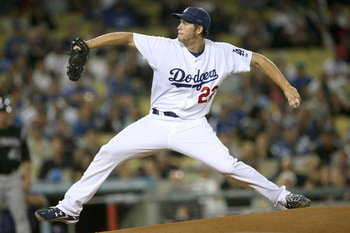
Ever wonder how a pitchers have the ability to throw the ball so incredibly fast? Part of the reason is God given talent and hard work. The other part has to do with the relationship between speed and force! Clayton Kershaw of the LA Dodgers pitches the ball in the mid 90s. To get the ball to travel that fast for about 60 ft and 6 inches takes quite a bit of force.